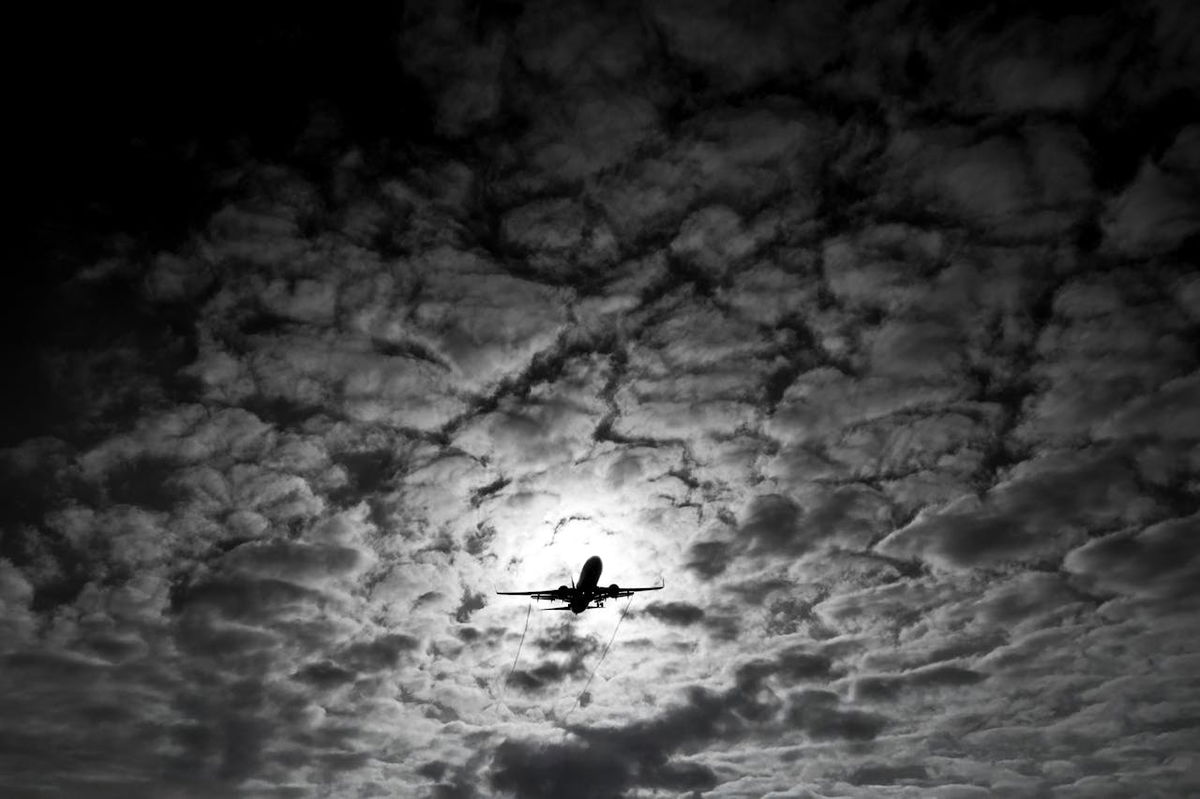
Flying is getting bumpier, and climate change is to blame. Scientists say turbulence in the skies is increasing worldwide, with the trend expected to worsen in the years ahead.
Air turbulence is becoming a growing safety risk
Turbulence has always been a part of air travel, but experts now warn it is intensifying. While modern aircraft are designed to withstand rough air, the main danger is passenger and crew injuries.
According to the US Federal Aviation Administration, there were 207 reported injuries on US commercial flights between 2009 and 2024. Some recent high-profile cases have highlighted the risks: 40 passengers were injured on an Air Europa flight last year, and a Singapore Airlines elderly passenger died during severe turbulence, with dozens more hurt.
Most Read on Euro Weekly News
 “>
“>
Boeing engine blows midair over Corfu
 “>
“>
Emergency landings: Spanish air traffic controllers on point
“Typically injuries (are) to unbelted passengers or cabin crew rather than structural damage,” said John Abraham, a mechanical engineering professor at the University of St. Thomas told AFP, cited by phys.org. “Modern aircraft withstand turbulence, so the main risk is occupant injury, not loss of the plane.”
Severe turbulence also forces pilots to change altitude or flight paths, leading to increased fuel consumption and delays.
Why climate change is making flights rougher
There are three main types of turbulence: convective (linked to storms), mountain wave, and clear-air turbulence (CAT). Of these, CAT is the most dangerous because it is invisible and undetectable by radar.
CAT usually forms around jet streams – fast-moving winds at cruising altitude. With the tropics warming faster than higher latitudes, climate change is intensifying wind shear and increasing the likelihood of CAT.
A 2023 study in the Journal of Geophysical Research: Atmospheres analysed data from 1980–2021 and found turbulence had risen by 60 to 155 per cent across major regions including the North Atlantic, North America, East Asia, and the Middle East.
“We find a clear, positive trend – an increase in turbulence frequency over many regions,” said Mohamed Foudad, atmospheric scientist at the University of Reading told AFP. He linked this rise directly to greenhouse gas emissions.
Research led by Isabel Smith at the University of Reading suggests that for every 1°C of near-surface warming, winter turbulence in the North Atlantic could rise by 9 per cent and summer turbulence by 14 per cent. Historically, winter was the bumpiest season, but warming is closing the seasonal gap.
Climate change is also fuelling stronger storms, further compounding the risk. “Climate change may also increase the frequency and severity of thunderstorms under future scenarios, and turbulence encounters near thunderstorms are a major component of turbulence accidents,” said Robert Sharman of the National Center for Atmospheric Research.
To reduce risks, researchers are working on better forecasting models and optimised flight paths. Airlines are also testing onboard LIDAR technology that uses lasers to detect air density changes. Some are considering stricter seatbelt policies and ending cabin service earlier during flights.
Ultimately, experts say cutting greenhouse gas emissions is key. Aviation accounts for around 3.5 per cent of human-caused warming, but progress on sustainable fuels has been “disappointingly slow,” according to the International Air Transport Association (IATA).
If turbulence becomes the new normal, what will that mean for those with a phobia of flying?
View all travel news.
View all environmental news.