Choosing the Right Index ETF: A Fun Guide for the Savvy Investor
Investing in index ETFs is like picking a playlist that rocks every time you hit play. You’ve got options like the S&P 500, Nasdaq 100, and Russell 2000, and each one has its own groove. Let’s break down what makes the top tracks stand out over the past two decades.
Quick Picking Rules (No Jargon, Just Juice)
- Go Low‑Fee, Keep It High‑Energy – All these ETFs chase the same target, the index. Paying more just means extra tax on your dance floor.
- Buy‑and‑Hold is the Royal Road – “I’ll just stay invested for the long haul,” is the mantra that turns a modest ≈10% annual return from the S&P 500 into a wealth‑building powerhouse.
- Contribute Regularly – Treat your portfolio like a savings plan that goes up and down like the market, but the trend is upward.
- Let Time Compound – A simple 10% a year, kept for years, grows like a stadium crowd that never stops cheering.
ETF Champions: How They’ve Been Doing Over 20 Years
Here’s the headline performance – total percentage gain, dividends included – that will tell you which ETF feels like the superstar:
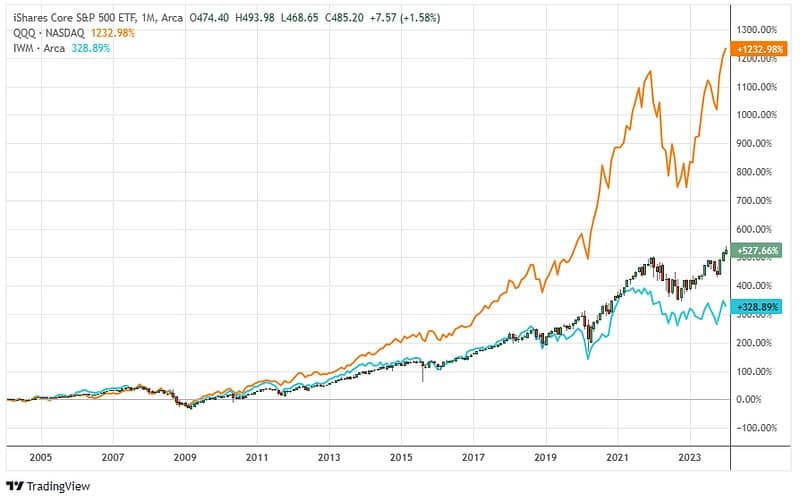
- S&P 500 (IVV) – +528%
- Nasdaq 100 (QQQ) – +1233%
- Russell 2000 (IWM) – +329%
As you can see, the Nasdaq 100 has been the absolute rockstar, soaring over a thousand percent. The S&P 500 delivers steady growth, while the Russell 2000 provides a modest climb for the smaller company lovers.
Three-Track Playlist: Why Mixing Them Might Be Smart
Why choose just one? You can finagle a mix:
- Keep the S&P 500 for solid, reliable beats.
- Add the Nasdaq 100 for that tech‑powered edge.
- Throw in the Russell 2000 for the small‑cap vibe.
Blend them, and you’ll get a diversified portfolio that doesn’t buckle when one track drops.
Remember: The Smart Move is Simple
The bottom line is this – low fees, consistent buying, and patience are the main ingredients to taste that sweet return. Don’t let market dips put a dampener on your enthusiasm. Just keep rolling and watch your portfolio grow from a humble seed to a towering tree.
Why the Nasdaq 100’s Glittering Past Doesn’t Mean a Bright Future
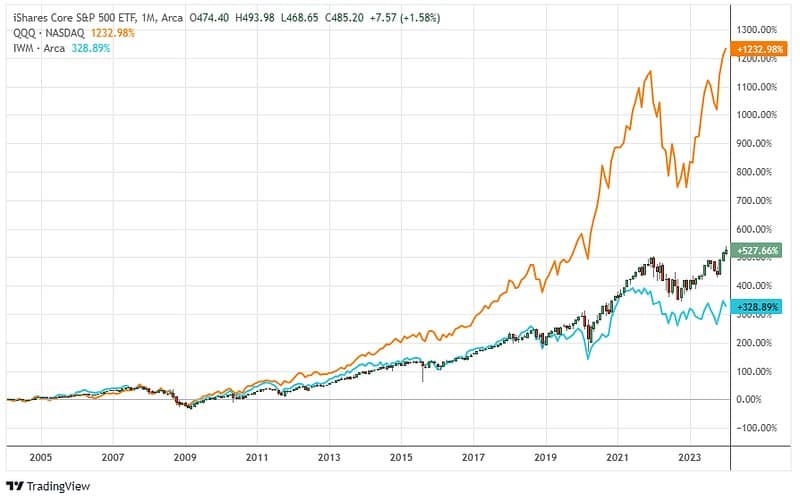
When you glance at a two‑year chart that only shines bright during boom times, it can feel like the Nasdaq 100 is the obvious pick. But that rosy picture? It’s a bit of a trick.
Hidden History Behind the Numbers
- All three ETFs – QQQ, IWM, and IVV – have been around since at least 2000.
- There was a massive crash from 2000 to 2003 that’s missing if you only look at the last 20 years.
- Back to mid‑2000, the returns line up: QQQ +488%, IWM +437%, IVV +426%. So the headline numbers are real, just not the whole story.
“Volatility” – The Old Nick and the Reality Check
The Nasdaq 100 is often called the roller‑coaster of the market. That’s not entirely wrong. It had a serious reality check in 2020 that reminded us it can dip sharply.
Crash‑by‑Crash Breakdown
- 2000–2002: QQQ fell 84%, IVV 49%, IWM 40%.
- 2007/08–2009: QQQ down 55%, SPY (the S&P 500) 56%, IWM 57%.
- 2020: QQQ slid 30%, IVV 35%, IWM 44%.
- 2021‑22 slump: QQQ dipped 37%, IVV 27%, IWM 33%.
What Does That Mean?
These stats paint the big highs and the painful lows that each fund has endured in the past two decades. Knowing that the big drops happened—especially in 2000 and 2020—helps you see that gains aren’t guaranteed to keep rolling forward.
Bottom Line: Past isn’t a Crystal Ball
History can guide you, but future moves are unpredictable. Use this data as your map, not a GPS. Pick the index that feels right for you, and remember: even the best‑performing funds can take a tumble.
Stay in the loop: get real‑time updates on this topic right on your device by signing up. Go ahead, subscribe and never miss a beat.